Inside the app
What elders see is exactly this simple
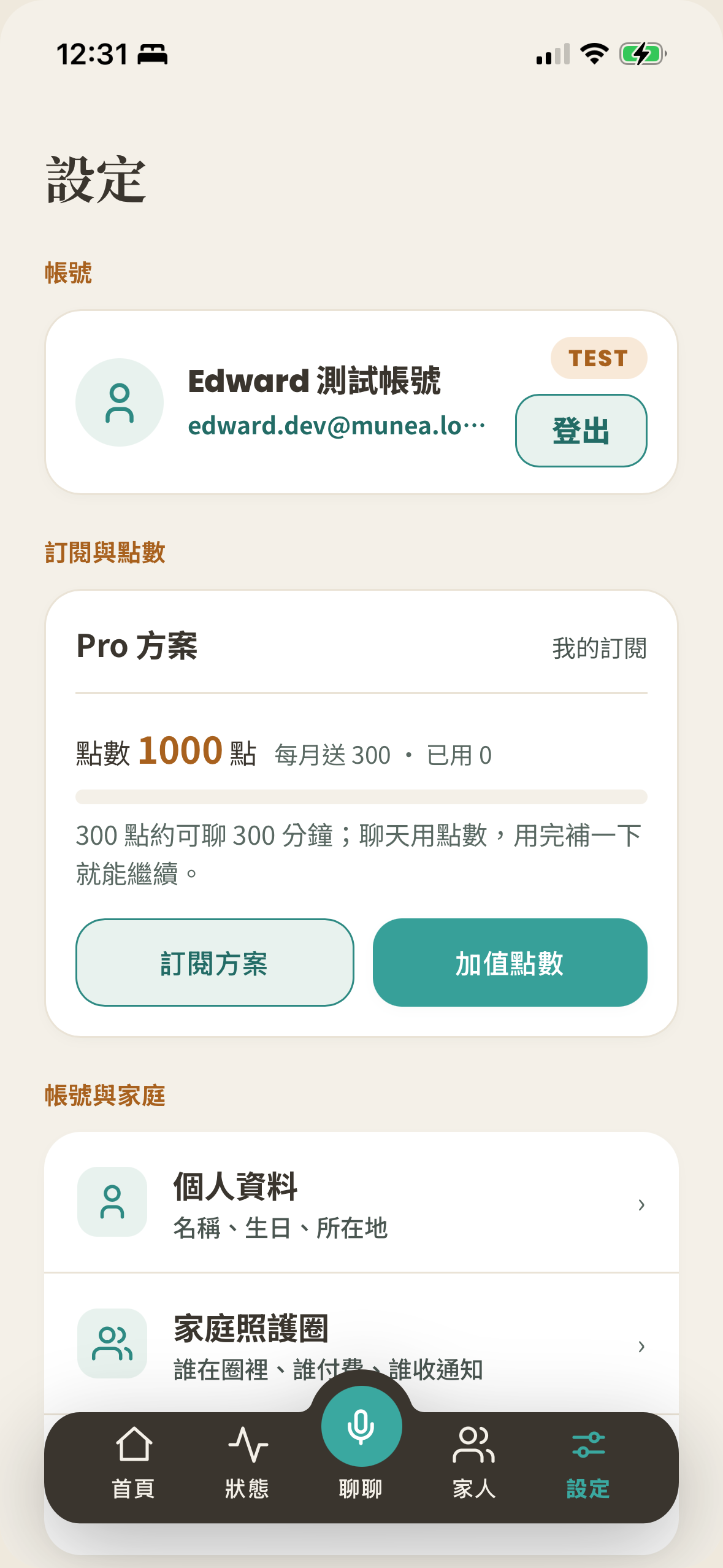
Big type, few buttons, just start talking. Every screen is designed for an elder's fingers and eyes.
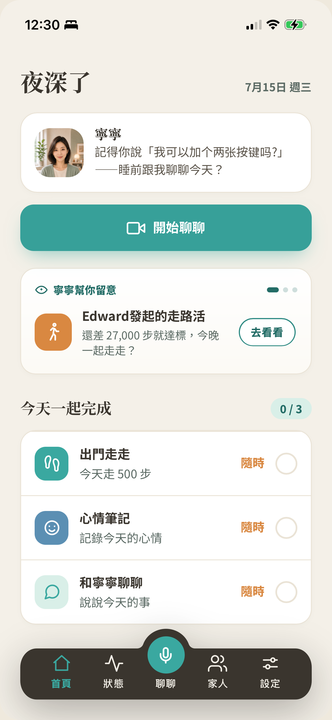
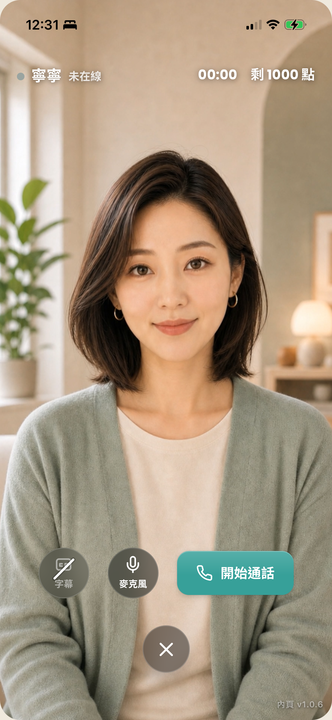
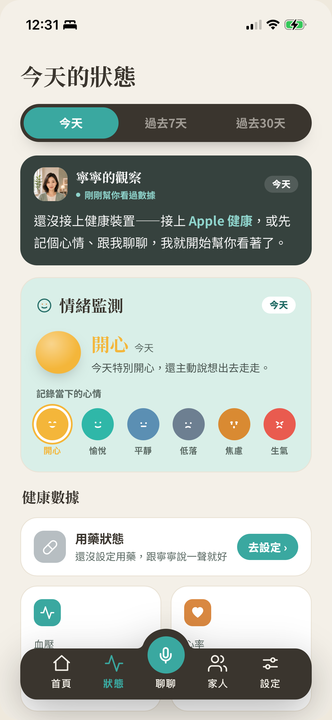
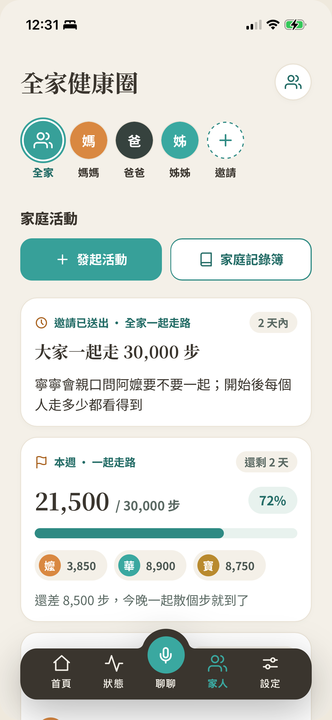
A real face and a real voice, talking with your elders every day, covering the nights, the quiet hours and the distance that no team can staff. Usage and care outcomes are visible every month, so ESG teams and families both have something to show.
Sources: Taiwan Ministry of Health and Welfare 2025・Taiwan long-term care staffing survey 2025・Nature loneliness research 2025・Grand View Research 2026
What buyers actually purchase isn't AI vocabulary. It's a service elders will use, front-line staff can read at a glance, and families can feel.
Long-term memory lets every conversation pick up where the last one ended: a sore knee, a grandchild's wedding, the old street they love to visit. She keeps it all. Familiarity is what makes an elder open the app a second and third time.
In everyday conversation she picks up low mood and warning signs: a voice that sounds off, a mention of pain, something worrying said out loud. Family and caregivers are notified right away, so "something's not right" becomes "we knew early".
Family open the app and see how Mom and Dad are doing today, their mood, and whether reminders were completed. Worry from far away finally has somewhere to go, instead of one phone call after another.
A proposal that closes has to answer all four at once: the manager's staffing problem, the front line's workflow problem, whether elders will actually use it, and whether families feel reassured.
Since 2022 New York State has placed AI companions in the homes of elders living alone. From the official tracking:
Elders started conversations 30+ times a day, six days a week — nobody made them. They wanted to talk.
In 2025 alone 3,500 elders applied to join, and the state keeps expanding the program.
Munea is doing the same proven thing for Taiwan's elders: in Mandarin, with a real face and a real voice, remembering every single person.
Source: New York State Office for the Aging (NYSOFA) official program reports, 2022–2026
Phase one focuses on long-term and day care, senior living, and family care support for employers. Other partnerships are open once a pilot confirms the need.
Big type, few buttons, just start talking. Every screen is designed for an elder's fingers and eyes.
A real face and voice, an ear for how Taiwan's elders actually speak, and memory of every conversation — the three foundations that let her keep showing up.
Real-time voice and face bring the interaction to life, and the character, the boundaries of care, Traditional Chinese for Taiwan and the family reporting flow all live in one experience. We don't ask you to buy on claims of being "first" or "ahead" that we can't prove.
The interaction layer makes elders want to talk, the care layer turns every sentence into protection, and the technology layer keeps it all running steadily. Together they add up to one assistant who remembers every elder, who can see and hear, and who calls for help when something happens.
Not a video, not a text chat. Once unlocked you go straight into a 3-minute real face and voice session, using only your microphone and your voice.
The passphrase is in our invitation message. Don't have one? Use "Book a 30-minute consultation" at the top right and we'll walk you through the whole thing ourselves.
This is an isolated guest session: no sign-in, no real user memory or health data, no reminders created. Please use Chrome or Safari and allow microphone access; waking the video service for the first time can take a moment. The demo is conducted in Traditional Chinese (Taiwanese Mandarin).
Start the 3-minute live demoA pure software subscription: employees download the app and start. No build-out, no implementation project. Buying in bulk, each corporate seat costs NT$100 less than the App Store price (Plus 599→499, Pro 1199→1099); 10 accounts or more include a monthly results report, and quarterly or analytical reports are a paid option. The figures below are reference starting points and don't imply unlimited calling.
| Type of partnership | Best suited to | How it's billed | Reference range |
|---|---|---|---|
| Facility seats | Long-term care・day care・senior villages・senior living | Per bed (unit) seat・monthly | From NT$499 / bed · month |
| Corporate ESG seats | Corporate HR and sustainability teams | Per employee-family seat・monthly (NT$100 less per seat than individual) | From NT$499 / person · month |
| Health center seats | Health centers・clinics・pharmacies | Per member seat・monthly | Quoted by membership size |
| ESG results reporting service | Add-on to corporate seats・for sustainability reports | Quarterly / annual | Quoted by scale |
| Alliances・white label・API | Channels・insurers・telcos・platforms | Revenue share・platform licence plus usage | By depth of partnership |
The figures above are reference ranges; formal quotes depend on scale and customization, and the signed contract governs.
Public funding that can go alongside adopting Munea:
We don't ask for a big contract up front: see it, try it, and only convert once it meets the targets.
Online or on site, talk with Munea yourself and see how she remembers people and holds emotion.
We learn your participants, language and network conditions, and deliver a pilot plan for you within two weeks.
Start with 10–20 participants and review weekly: how easily it's used, what families say, and where a human had to step in.
Against the targets agreed in advance, decide to expand, adjust or stop. Final pricing and scope of responsibility are confirmed in the contract.
Three things, stated up front:
Munea is an assistive care and reminder tool. It does not replace human care or emergency medical judgment, and it does not provide diagnosis or medical advice. The escalation flow and responsibilities for warning signs are defined explicitly in the contract.
Elders' conversations and health data are collected and processed under Taiwan's Personal Data Protection Act, with consent forms, data processing agreements, retention limits and purpose limitation all in place. Data is never used for anything outside the service.
The service runs primarily in Mandarin, tuned to how people in Taiwan speak. Taiwanese Hokkien is still being improved, and we can assess your setting's language needs before rollout. Other languages are not supported today.
Everyone is teaching AI to answer questions.
We chose to teach AI to care.
See it, try it, expand once it works.